Summer Tracing and Coloring: A Creative Activity for Kids
When the school year winds down and the long, sunny days of summer begin, keeping young minds engaged and learning can feel like a challenge. Parents and educators often seek activities that are not only fun but also beneficial for developmental skills. This is where a well-designed resource like a Tracing and Coloring Activity for Summer becomes invaluable. It’s more than just a way to pass the time; it’s a tool that blends creativity with crucial fine motor skill practice in a way that feels purely like play.
Understanding the Visual Appeal and Design
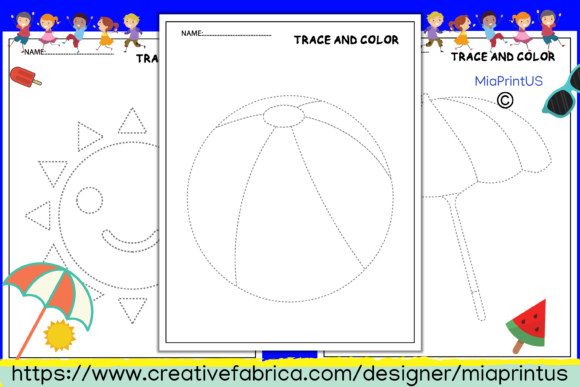
The core of any successful children's activity sheet lies in its design. For a summer-themed tracing and coloring set, the imagery is paramount. Think of the icons of the season: a smiling sun, a dripping ice cream cone, a playful beach ball, a sturdy umbrella, or a juicy slice of watermelon. The visual characteristics of a high-quality set, like the one described, prioritize clarity and accessibility. The lines are thick, dark, and unambiguous, which is essential for a child just learning to control a pencil or crayon. This isn't about intricate, delicate linework; it's about providing a clear path for small hands to follow.
The personality of such a design is inherently festive, fun, and exciting. It should evoke the carefree spirit of summer vacation. The style is intentionally simplified, removing unnecessary complexity so the child can focus on the task of tracing the shape and then bringing it to life with color. This approach respects the developmental stage of its primary users—kindergarteners and toddlers—while offering enough charm to keep older kids interested. The overall appeal is one of cheerful accessibility, inviting participation rather than intimidating with difficulty.
Practical Applications Beyond the Classroom
While a tracing and coloring worksheet is a staple in kindergarten classrooms, its utility extends far beyond formal education. For entrepreneurs and creators in the KDP (Kindle Direct Publishing) space, this type of design asset is a perfect fit for the low-content book market. A compiled book of summer tracing and coloring pages can be a profitable niche product, especially when marketed towards parents, grandparents, and preschool teachers looking for screen-free activities.
For bloggers and content creators in the parenting, education, or lifestyle niches, offering a free printable tracing page is a fantastic lead magnet. It provides immediate, tangible value to your audience, builds your email list, and establishes your authority as a helpful resource. Similarly, small business owners—like local daycare centers, pediatric occupational therapists, or children's party planners—can use these sheets as part of their service offering, enhancing their customer experience with a thoughtful, practical touch.
Influence on Development and Engagement
The impact of a simple tracing activity is profound. It directly influences readability in the child's own future writing by building the muscle memory and control needed for letter formation. The act of tracing lines, shapes, and eventually letters and numbers lays the foundational visual hierarchy for how we organize information on a page. For the adult creating or publishing these materials, choosing a resource with clear, consistent designs contributes to the professionalism of your final product, whether it's a printed book, a downloadable PDF, or a set of social media graphics promoting a summer camp.
The brand perception for a business using such materials is one of care and attention to detail. It shows you understand the needs of your audience—parents who want enriching activities for their children. This consistency in providing quality resources builds recognition and trust. The engagement is twofold: the child is engaged in the creative task, and the parent or educator is engaged with your brand as a provider of valuable solutions.
Guidance for Selecting and Using These Resources
If you're considering integrating a Tracing and Coloring Activity for Summer into your projects, here’s some practical advice. First, evaluate the quality of the design assets. Look for high-resolution images (like 300 DPI JPGs or print-ready PDFs) to ensure they look crisp when printed. Check that the lines are indeed thick and dark, as faint, thin lines can frustrate young users.
Consider the variety within the set. A good collection offers a range of images—simple shapes, familiar objects, and perhaps some letters or numbers—to maintain interest and provide graduated challenges. Think about your specific use case. For a KDP business, a cohesive set of 30-50 pages makes a compelling book. For a lead magnet, a single, beautifully designed page is sufficient.
While this isn't about font pairing in the traditional typography sense, the principle is similar. The tracing lines themselves are the primary "typeface" of the activity. They must be clear and purposeful. Any accompanying instructions or titles should use a simple, legible sans serif font that doesn't compete with the activity itself. The goal is a harmonious brand identity for your product or resource, where every element supports the core experience of tracing and coloring.
In the end, a thoughtfully designed summer tracing and coloring activity is a powerful creative font of engagement for children. It’s a bridge between play and learning, and for the adult professional, it’s a versatile and valuable asset that can enhance educational offerings, content strategies, and commercial products. Its strength lies in its simplicity, its developmental value, and its universal appeal during the sunniest season of the year.